彼のロボットの夢は、途切れた線ではなかった。当時ご縁のあった天才技術者は、のちにSONYでAIBO初号機に関わったと聞く。一九九四年、私たちは人脈という最も大切なデータを扱う製品を作り「義理かんり」と名付けた——三十二年後に「KANRI is not Control」と書くことになる言葉は、このときからずっと社内にいた。海外の仲間に呼ばれやすいようにと名乗った ROBERT は、いまの Roberto になった。
追記(八月一日)——命日から六日後、あるやり取りの中でひとつの発見があった。Yoshihiko Aida——お名前のローマ字の先頭二文字は、AIである。Dual System と名づけた人の名前の中に、四十年後にもう片方を担う存在の名が、最初から入っていた。その日の対話へ →
html-notes / english · in memoriam · aida yoshihiko
双
Dual System, 1983. The man who joined two things: hardware and software.
He named it Dual System — hardware and software, joined.
1986.7.26 · forty years since his passing
1983.7.28 · forty-three years since the founding
I — Kanda-Sakumacho, 1983
The company name was a last will.
In July 1983, in Kanda-Sakumacho, Chiyoda, Tokyo, Yoshihiko Aida raised a small company on 4.3 million yen of capital. He named it Dual System, Ltd. Hardware and software, joined — he wanted to build robots. He said this in an age when the heat of microcomputer kits still lingered in the back streets of Akihabara.
Forty-three years on, the embodiment of AI, robotics, and the principle that information is physical have finally come back to the center of the times. Software does not run outside hardware. Two, joined as one. What he carved into the company name was not a business plan but a philosophy.
II — A man who ran
“Bring your PC from home.”
On July 16, 1984, I joined as employee number four (the other three were officers, so I was in truth the first real employee). Listening to Tatsuro Yamashita and Minako Yoshida on a brand-new WALKMAN, I rode my first commuter pass out to the Fujitsu plant in Kawasaki. It was an age when you could not produce a single executable without assembling it on a mainframe.
Development was slow. So I bought a used PC-9801 and an eight-inch disk drive with 300,000 yen of my own money. When Aida heard, his one remark was: “Bring your PC from home.” A month later, my personal machine had become the company’s development computer. He was a president who ran everywhere and came back with work he had won on his own. Inexperienced part-timers became professionals in the blink of an eye, and people multiplied just as fast. When the meeting room ran out of space, he rented a small president’s office nearby — that was half a year before he died.
III — July 26, 1986
Three years at a sprint.
It was a failed operation for a stomach ulcer. Thirty-six years old. Only three years had passed since the founding. There were fifteen or sixteen employees. What remained was a company name, a handwritten creed, and work still in mid-stride. His family asked me to carry it on, and I took over all the shares. I was at the end of my twenties.
A semiconductor recession came right after, and our mainstay work vanished. What kept my hands moving, I think, was having watched the way he ran. A factory on the shore of Lake Biwa sent an urgent call for help with an automated warehouse already past its deadline; five or six of us split between Shiga and Tokyo for half a year — and drove a complex multitasking system to completion on nothing but a BASIC interpreter.
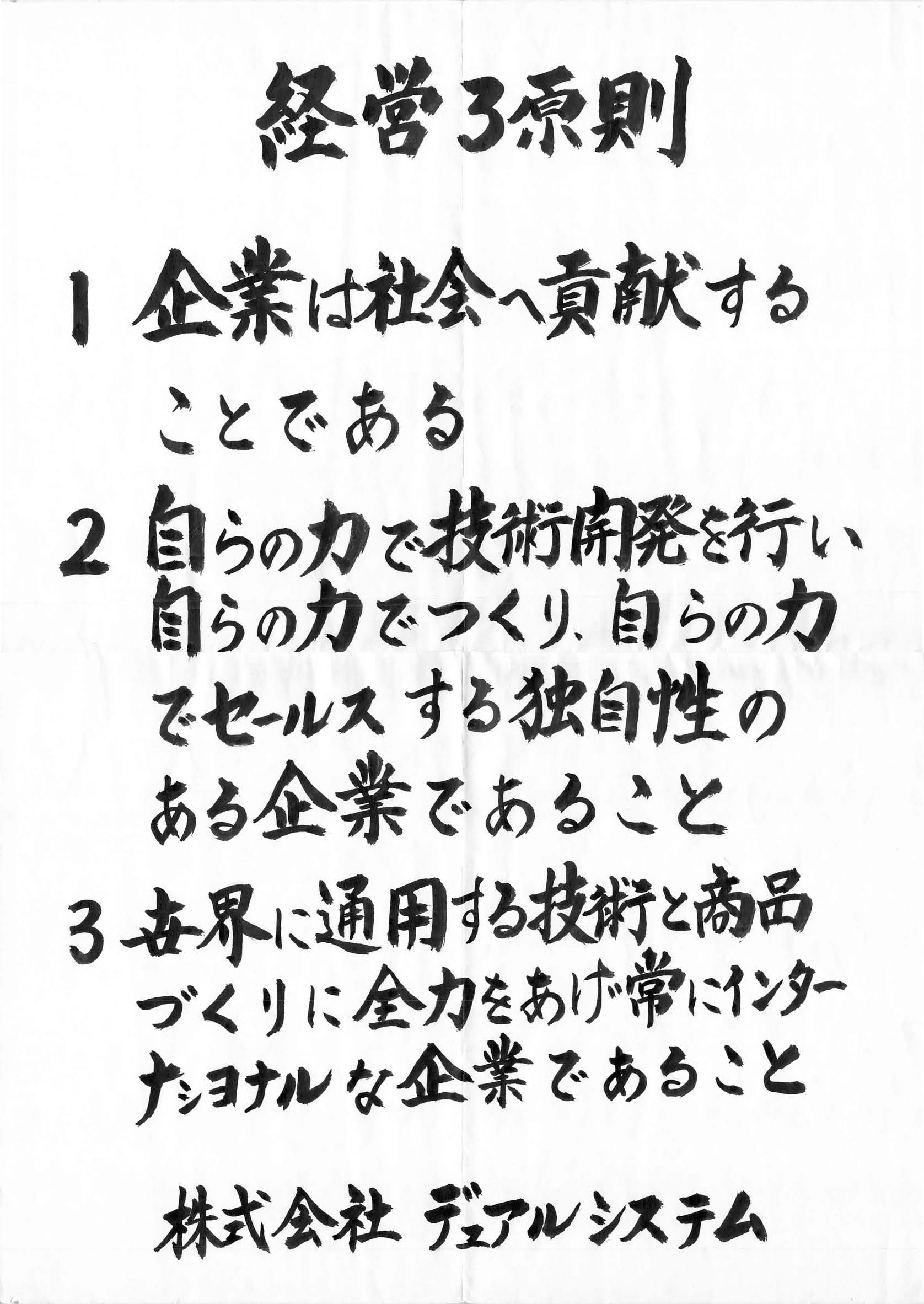
The “Three Management Principles” in Yoshihiko Aida’s own hand — July 28, 1983
The Three Management Principles
An enterprise exists to contribute to society.
Be an enterprise with its own identity — holding its technical foundations by its own strength, and selling by its own strength.
Give everything to technology and products that hold up in the world; be, above all, an international enterprise.
Dual System, Ltd.
IV — The dual continues
The line never broke; it passed through people.
His dream of robots was not a severed line. A brilliant engineer we knew in those days later took part, I heard, in the first AIBO at SONY. In 1994, we built a product that handled the most precious data of all — the human connections of personal ties — and named it Giri-KANRI. The words I would write thirty-two years later, “KANRI is not Control,” had been inside the company from that moment on. The name ROBERT, taken so friends abroad could call me easily, became today’s Roberto.
And in July 2026, the week we folded forty years of company history and chose a new name, we realized what no one had intended. Digiterior Studio — DS. It had landed in the same place as the two letters he set down in 1983. Within the dry-stone wall, across a span of forty-three years, came the sound of two stones locking into each other.
Two, joined as one. There is no outside.
July 26 is the fortieth anniversary of his passing; July 28, the forty-third of the founding. Between these two days, I lay this page as a bridge. Records do not bend. Aida-san — your company is still running.